
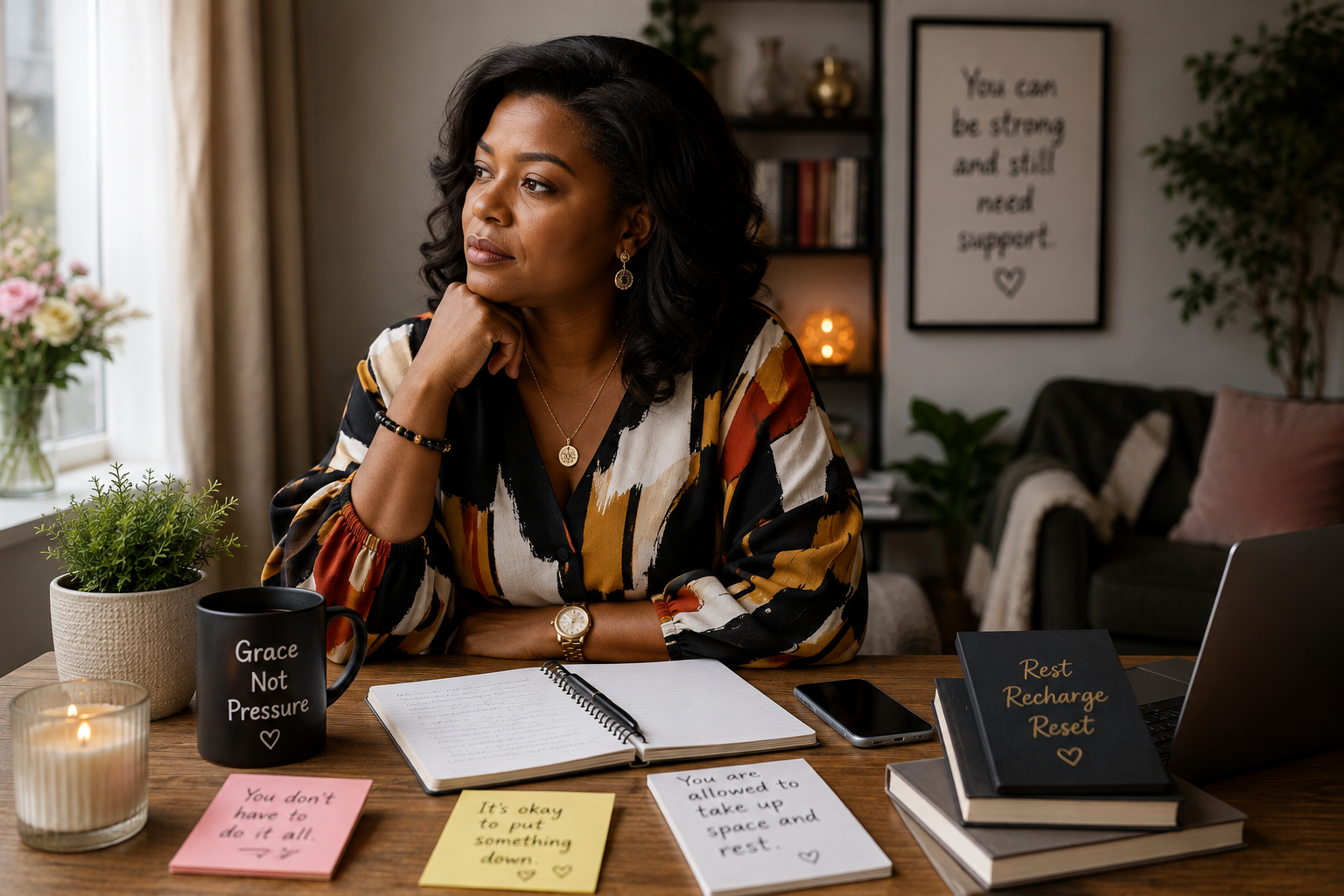
I had an in-depth discussion with a colleague of mine the other day about women and their mental health, and I shared something with her.
There is something about the human heart that continues to amaze me. We can be hurt, overwhelmed, disappointed, or simply tired, and still somehow find a way to keep going.
When was the last time somebody asked you how you were doing—and you actually told them the truth?
Not the automatic “I’m fine.”
Not the polite smile.
Not the “I’m just a little tired.”
I mean the real answer.
“I’m exhausted.”
“I need a break.”
“I don’t know how much longer I can keep doing everything.”
And perhaps the strangest thing is that sometimes, nobody even knows you are struggling.
Because you have become very good at looking like you have everything under control.
I know something about that.
In fact, I might be talking about myself here.
I am that woman who finds it difficult to delegate
Let me confess something.
I am that woman who finds it difficult to delegate duties.
Especially at home.
If something needs doing and I can do it myself, there is a very good chance I will simply get up and do it.
Why ask someone else when I can handle it?
Why leave it until later when I can sort it out now?
Why delegate when, in my head, I already know exactly how I want it done?
You see where this is going, don’t you?
Before long, I have taken on several things that I didn’t necessarily need to carry.
And then I wonder why I am tired.
Sometimes I have to laugh at myself because I know exactly what I am doing.
I take on the responsibility.
I keep going.
I solve the problem.
I make sure everyone is okay.
And somewhere in the middle of all of that, I quietly forget to ask myself whether I am okay.
And then there is my complicated relationship with rest
I hardly rest.
I am not even sure when this became such a normal part of my personality.
Taking a proper break can sometimes feel like another task I have to schedule.
Even when I sit down, my mind is usually busy.
There is something else that needs doing.
Something else that needs organising.
Something else I could be doing with my time.
And before I know it, I am back on my feet again.
This is just me.
But I have also had to recognise something about myself:
Just because something is “me” does not mean it is always good for me.
That one took me a while to understand.
Because we can become so comfortable with our patterns that we start calling them personality.
“That’s just how I am.”
“I don’t like asking for help.”
“I prefer doing things myself.”
“I don’t need much rest.”
“I’ll be fine.”
But sometimes, beneath those statements is a woman who has simply become accustomed to carrying too much.
And if you have ever reached that point where even taking care of yourself feels like another responsibility, I have written about that struggle before in When There Is Zero Energy for Self-Care: How ’80s and ’90s Music Saves My Sanity.
Being strong can become exhausting
There is something admirable about being dependable.
People know they can count on you.
You show up.
You get things done.
You keep your promises.
You take care of things when they need taking care of.
And perhaps people have even described you as strong.
But sometimes I wonder whether we have romanticised strength a little too much.
Because what happens when everyone knows you as the strong one?
Who checks on you?
Who notices when you are running low?
Who tells you that you don’t have to solve everything?
Who gives you permission to say:
“I can’t do this today.”
The strong woman can become a victim of her own reputation.
Not because the people around her necessarily intend to take advantage of her, but because she has become so accustomed to coping that nobody realises she needs support too.
And sometimes, neither does she.
There is a difference between coping and constantly carrying
I think this is something we don’t talk about enough.
There is a difference between being resilient and being permanently exhausted.
There is a difference between being responsible and believing everything is your responsibility.
There is a difference between being independent and refusing to accept help.
And there is certainly a difference between having a lot to do and never allowing yourself to stop.
You can cope with something for a very long time and still find it exhausting.
You can be grateful for your life and still admit that parts of it are difficult.
You can love your family and still need time away from your responsibilities.
You can be a strong woman and still have days when you don’t feel particularly strong.
Two things can be true at the same time.
Sometimes the woman who needs help is the one giving it
This is something I have been learning.
We are often very generous with other people.
We tell them to rest.
We tell them not to feel guilty about taking time for themselves.
We tell them that asking for help is okay.
We remind them that they cannot pour from an empty cup.
And then we turn around and completely ignore our own advice.
I know I have done this.
I can look at another woman who is overwhelmed and immediately recognise that she needs a break.
But when it is me?
Suddenly there is another thing to do.
Another responsibility.
Another reason why now isn’t the right time.
Another “I’ll rest later.”
Except later has a funny way of becoming tomorrow.
And tomorrow becomes next week.
And eventually, you realise you have been functioning on empty for longer than you care to admit.
This is one reason I think it is important to pay attention to emotional exhaustion rather than simply celebrating how much we can endure. I explored this more deeply in When You’re Emotionally Drained but Life Doesn’t Stop: How to Keep Going Without Burning Out.
What if you stopped trying to do everything yourself?
This is probably where I should tell you that I have completely mastered delegation.
I haven’t.
I am still learning.
But I am beginning to understand that delegating does not mean I am incapable.
It does not mean I am lazy.
It does not mean I don’t care.
And it certainly does not mean that everything will fall apart because I allowed someone else to help.
Sometimes, delegation simply means recognising that I am one person.
I don’t have to prove my worth by how much I can carry.
I don’t have to earn rest by exhausting myself first.
And I don’t have to wait until I am completely drained before I admit that I need a little help.
In fact, guidance from Mind on managing stress and building resilience includes practical suggestions such as taking breaks, organising your time and asking someone you trust for help.
That sounds simple, doesn’t it?
But sometimes the simplest things are the ones we find hardest to give ourselves permission to do.
Give yourself permission to put something down
Maybe you are reading this and thinking about all the things currently sitting on your shoulders.
Work.
Children.
Marriage.
Housework.
Family responsibilities.
Finances.
Relationships.
Expectations.
Other people’s needs.
And perhaps your own needs are somewhere at the bottom of that very long list.
If that sounds familiar, I want you to pause for a moment.
Not because I am about to give you a ten-step plan for transforming your life.
I don’t have one.
I am still figuring this out myself.
But perhaps we can start somewhere much simpler.
What can you put down?
What is one thing you don’t have to do today?
What is one task somebody else could help you with?
What is one responsibility you have taken on simply because you are used to being the person who handles everything?
And when was the last time you took a break without feeling guilty about it?
You don’t have to answer all of those questions today.
Just think about them.
And if the pressure you are carrying is beginning to feel difficult to manage, the NHS advice on stress is a useful place to find practical information about recognising stress, coping with it and knowing when to seek further support.
You are allowed to be more than the strong one
Perhaps you have spent years being the dependable one.
The one who keeps going.
The one who holds things together.
The one who remembers everything.
The one who makes sure everyone else is okay.
But you are allowed to be the woman who needs somebody else sometimes.
You are allowed to say, “Can you help me with this?”
You are allowed to take a Saturday afternoon and do absolutely nothing productive.
You are allowed to sit down.
You are allowed to change your mind.
You are allowed to rest before you are completely exhausted.
And you are allowed to admit that sometimes life is simply a lot.
None of that takes away from your strength.
If anything, perhaps recognising your limits is another form of strength.
Because there is nothing particularly courageous about running yourself into the ground simply because you are capable of doing so.
I am still learning this too
I won’t sit here and pretend I have figured it all out.
I am still the woman who sometimes wants to handle everything herself.
I am still the woman who finds delegation difficult.
I am still the woman who can turn a perfectly reasonable day into a list of twenty things that must be done.
And yes, I am still learning how to rest.
But perhaps that is the point.
We don’t have to have everything figured out before we start treating ourselves with more kindness.
Maybe today I will delegate one thing.
Maybe tomorrow I will take a proper break.
Maybe I will allow someone else to help without mentally supervising how they are doing it.
Small steps.
Because perhaps taking care of ourselves isn’t always about making dramatic changes.
Sometimes it is simply recognising that we matter too.
And if you are the woman who has been holding everything together for everyone else, I hope you remember this:
You don’t have to fall apart before you are allowed to rest.
You don’t have to become completely exhausted before you are allowed to ask for help.
And you certainly don’t have to prove how strong you are by carrying everything alone.
Sometimes strength looks like getting back up.
But sometimes, my dear reader, strength looks like finally sitting down.
And perhaps that is something I—and many of us—need to learn.