
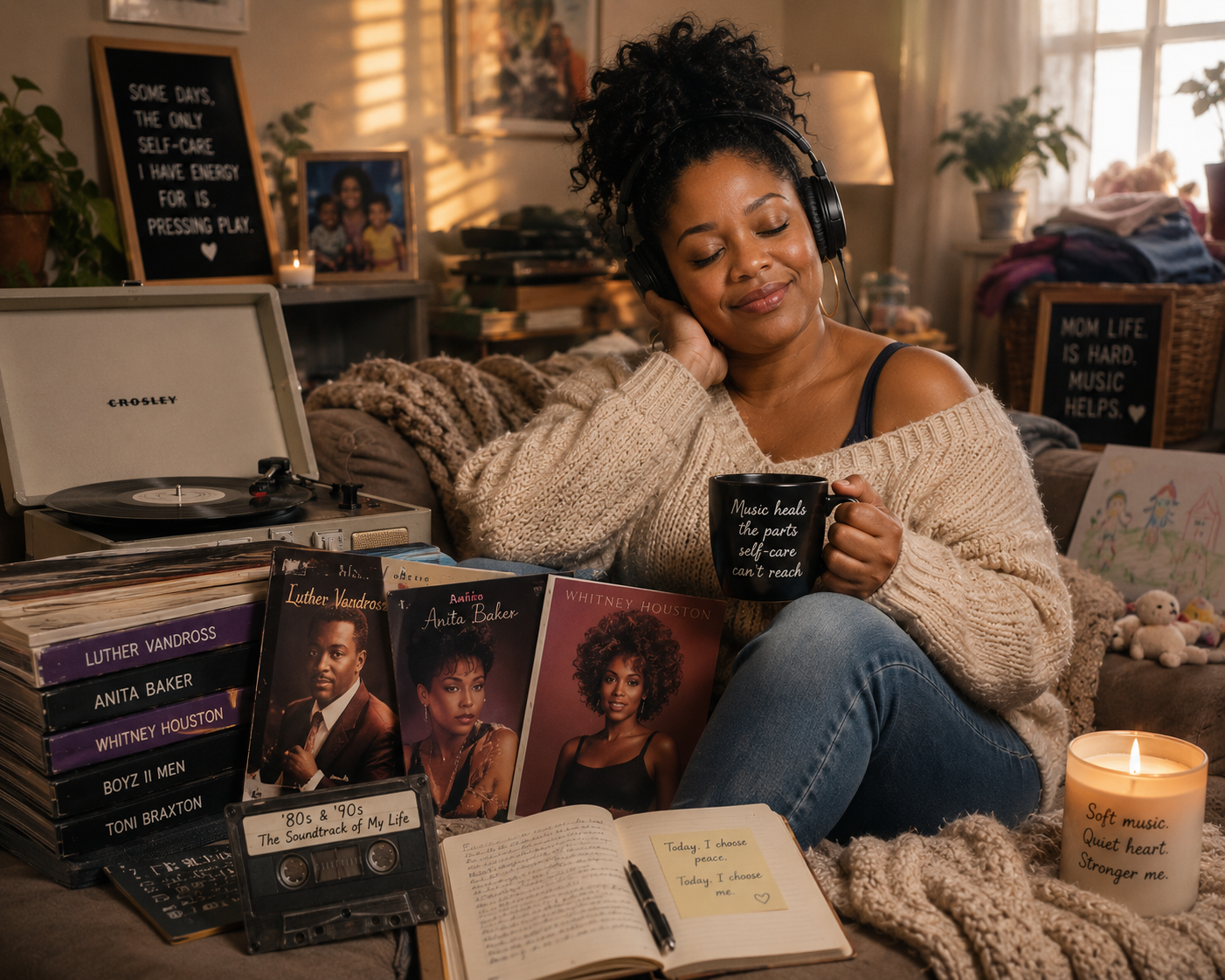
As a millennial woman raising kids, managing a family, and juggling careers, I’ve discovered that 80s and 90s music for self-care is sometimes the only thing that helps me through emotionally exhausting days. There are moments when the weight of all these responsibilities presses so firmly against my chest that getting out of bed feels like climbing a mountain barefoot. During those days, breathing feels like work. My body moves like it’s wading through molasses, and my mind spins with a thousand unfinished to-dos. 8 Signs You’ll Expеriеncе Whеn Your Mеntal Hеalth Is Falling Apart
In those days, people would say, “Take care of yourself.”
And I want to scream.
Consequently, they don’t see all the to-do lists that include running to the stores for groceries, signing school forms, completing office E-Learning courses, picking up kids after school, meal planning that never seems to end, and assisting the children with home lessons, while still providing them with all the attention and care they need. Even five minutes with myself feels like asking for the moon.
On those days with zero energy, I don’t take walks. I don’t take a luxurious bath like I usually do with a novel in my hands. I don’t dip my feet in warm water for comfort and relaxation. Instead, I reach for music because when I don’t have the energy to do anything for myself, music does everything for me.
In the chaos, in the mess, in the weight of motherhood, it gives me back pieces of myself I had forgotten existed. Psychology Today explored this in their article, Music Is Good for the Soul, and Your Health
The Quiet Comfort of Rhythm and Blues
If you enjoy music of the 80s and 90s, as I do, you would notice that listening to Luther Vandross brings back memories of quiet Sunday mornings when all was still, peaceful, and no one needed anything from me. A velvet hug, his voice wraps itself around me as he sings. No expectations, no demands. It’s just comfort
The music of Luther Vandross can be described as polished, sophisticated, and deeply emotional, with velvety-smooth vocals that are complemented by powerful, emotional lyrics. With a unique sense of grace and sensuality, he writes about love, romance, and heartbreak in the “Quiet Storm” genre—the kind of themes that appeal to me.
It wasn’t just love songs that Luther Vandross sang; he spoke about the journey of love as well. My life’s most romantic and heartbreaking moments have been accompanied by his music, making me feel understood at every turn.
With his discography, he explores romance from all angles. There are songs for every phase: the longing for love, the intense desire, and the pain of losing it.
In Luther Vandross’ songs, I don’t just listen, I feel them. From the quiet moments of deep affection to the raw worry of love hanging by a thread, he captured the full spectrum of love.
Music as Self-Care When Self-Care Feels Impossible
The truth is, there are seasons in life when self-care must not involve spa days, scented candles, yoga classes, or long walks in the park.
Self-care can be as simple as surviving the day without falling apart.
Researchers have long known that music can calm both the mind and body. It can lower stress hormones in the brain, regulate breathing, slow the heart rate, awaken memories, and even help to process emotions that do not yet have words to describe. Unlike many forms of self-care that require energy, planning, or money to implement, music simply asks me to press play.
For mothers especially, whose days are often spent meeting everyone else’s needs before their own, music becomes a permission to feel.
It reminds us of the woman beneath the school runs, packed lunches, work deadlines, and endless laundry.
Sometimes, a four-minute song accomplishes for me what a full afternoon off cannot.
You will do yourself a lot good by reading this article, Music and Health: What You Need To Know compiled by NCCIH.
Why Luther Vandross Still Feels Like Home
Luther Vandross understood emotions with extraordinary tenderness.
His voice was never demanding of attention. It was inviting.
Listening to him after a difficult day feels like sitting with an old friend who doesn’t rush to solve your problems but simply stays with you while you breathe.
When the song “Here and Now” comes on, I am reminded of the idea that true love can be gentle.
When “Dance With My Father” plays, it opens a quiet space for grief, remembrance, and gratitude.
When “Never Too Much” fills the room, it’s impossible not to smile, even if only for a moment.
His songs remind me of the importance of not rushing to find a solution to the emotional turmoil that we face within ourselves.
Sometimes,oue emotions don’t need to be fixed. They simply need to be acknowledged.
Then Come the Other Voices of My Generation
Luther isn’t the only one who keeps me emotionally afloat.
There are days when I need the warmth of Anita Baker. One can never be wrong to say that her voice feels like candlelight in human form.
Whitney Houston is one lady who reminds me that strength and vulnerability can exist in the same heart.
When life feels uncertain, Boyz II Men transport me back to the simpler years of my life, when my biggest concerns were school assignments and choosing which cassette to play next.
Then there are the voices that shaped my generation—Celine Dion, Mariah Carey, Brian McKnight, Toni Braxton, Peabo Bryson, Michael Bolton, Babyface, and Lionel Richie. Their music carries pieces of my younger self.
Their music carries pieces of my younger self.
It reminds me of who I was before adulthood.
The Beautiful Thing About Nostalgia
Scientists refer to this phenomenon as nostalgic memory.
I simply call it going home.
Music from our younger years becomes woven into our life stories. Hearing a familiar song from our past can instantly transport us back to a specific moment, a particular place, or someone we once loved.
Sometimes I am no longer standing in my kitchen trying to decide what to cook for dinner.
I am sixteen again.
Or twenty-two.
Or newly married.
And dancing without worrying about tomorrow.
For a few precious minutes, my nervous system remembers what peace once felt like.
And surprisingly, that’s enough to help me keep going.
Self-Care Doesn’t Always Look Beautiful
Social media has succeeded in convincing many of us that self-care has to be aesthetic.
You decorate the atmosphere with beautiful candles.
You engage with luxury skincare.
You organize weekend retreats.
You create perfectly organised journals.
All these are lovely if you have the energy.
But what about the mother who hasn’t had a proper sleep in weeks?
What about the woman struggling to balance work, children, ageing parents, financial worries, and emotional exhaustion?
What if all she has enough strength to do is put on her headphones?
That counts too.
Healing doesn’t always arrive dressed as a luxurious self-care routines.
Interestingly, it arrives through an old CD, a forgotten playlist, or a familiar voice singing words you’ve known for decades.
Has My Playlist Has Become My Therapy Room?
The answer is no.
Music doesn’t take away my problems or my worries.
The laundry still awaits me.
The emails still need my attention and replies.
The school forms are still waiting to be signed by me.
But somehow, after listening to three or four songs, my motivation returns.
My shoulders are more relaxed
My breathing becomes steadier.
The tightened knot in my chest is loosened.
I haven’t escaped my life.
I’ve simply found a whole new strength to return to it.
Personally, that’s all self-care needs to accomplish for me.