
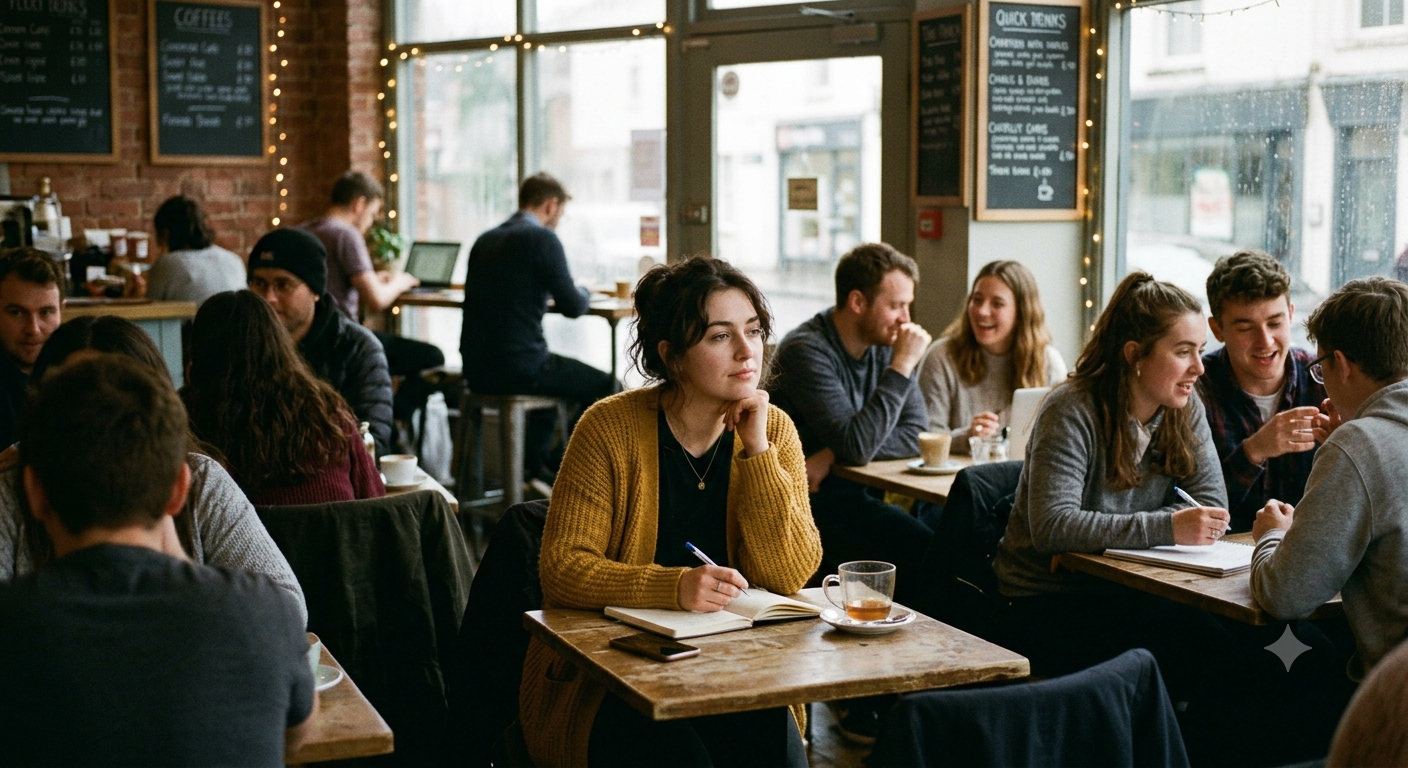
Have you ever looked around and wondered how it is possible to be surrounded by people and still feel completely alone?
I have.
And perhaps that is one of the strangest things about life today. We have more ways to communicate than any generation before us. We can send a message across the world in seconds, video-call someone who lives thousands of miles away, comment on someone’s post and know what they had for breakfast without ever actually speaking to them.
Yet somehow, real connection can still feel incredibly difficult to find.
I think about this even more as an immigrant woman living in the UK.
When you move to another country, you don’t just leave a physical place behind. You leave familiar faces, spontaneous visits, neighbours who know you, friends who understand your history and sometimes even the simple comfort of being somewhere you don’t have to explain yourself.
You arrive with hope. You meet people. You go to work. You smile. You have conversations.
And still, there can be moments when you quietly think:
“Where are my people?”
That question is not always about needing hundreds of friends. Sometimes, it is simply about wanting one or two people you can genuinely connect with.
Someone you can call without rehearsing what you want to say.
Someone you can sit with without feeling like you have to perform.
Someone who asks, “How are you?” and actually waits for the real answer.
That is what makes our need for connection so interesting. We don’t necessarily crave more people. We crave meaningful people.
And in an age where we can be constantly connected digitally while feeling emotionally disconnected in real life, perhaps we need to start talking about that more openly.
What Does It Really Mean to Crave Connection?
Loneliness is not necessarily the same thing as being alone.
You can spend an entire weekend by yourself and feel perfectly content. You can also sit in a crowded room, attend a family gathering or spend eight hours at work surrounded by colleagues and still feel like nobody really sees you.
The NHS recognises different experiences of loneliness, including emotional loneliness, social loneliness and the feeling of being surrounded by people while still feeling alone. NHS Every Mind Matters: Loneliness
That distinction matters.
Because sometimes what we are craving is not company.
We are craving connection.
The kind that makes you feel heard.
The kind that allows you to laugh without pretending.
The kind where you don’t have to constantly wonder whether you are being accepted.
The kind where you can say, “Today has been a terrible day,” without immediately feeling the need to explain or apologise.
The World Health Organization describes social connection in terms of how people relate to and interact with one another, while loneliness is the distress that can arise when the connections we have don’t match the connections we want or need. WHO: Social Connection
And that, to me, explains so much.
When Moving Abroad Changes Your Social Circle
Moving abroad can be exciting.
It can also be incredibly lonely.
You may find yourself having to build friendships from scratch as an adult. You may have left behind people who knew you before marriage, motherhood, career changes, responsibilities and all the other things life throws at us.
Suddenly, you are introducing yourself all over again.
You are learning a new environment.
You are figuring out where to shop, where to worship, where to work, how things are done and how to navigate a culture that may not always feel familiar.
And somewhere in the middle of all that adjustment, you are also expected to build a social life.
But friendship doesn’t always happen as easily in adulthood as it did when we were younger.
At school, friendship could begin simply because someone sat beside you.
As adults, we have responsibilities.
Work.
Children.
Partners.
Bills.
Housework.
Deadlines.
Sometimes by the time the day is over, the last thing we feel like doing is getting dressed and going somewhere to meet people.
So we retreat.
We tell ourselves we are tired.
We tell ourselves we’ll call someone tomorrow.
Tomorrow becomes next week.
Next week becomes next month.
And without realising it, our world becomes smaller.
Why Is It Sometimes So Difficult to Reach Out?
There are days when I understand why people withdraw.
Perhaps you have been hurt before.
Perhaps someone you trusted disappointed you.
Perhaps you have experienced rejection.
Perhaps you have spent so much time caring for everybody else that you no longer know how to ask someone to care about you.
Or perhaps you are simply afraid.
“What if they don’t like me?”
“What if the words don’t flow well?”
“What if I reach out and they don’t respond?”
“What if I make myself vulnerable and regret it?”
These questions can keep us safely inside our own little bubbles.
But the problem with a bubble is that although it can protect you from disappointment, it can also keep connection out.
And sometimes, the very thing we are protecting ourselves from becomes the thing we end up experiencing: loneliness.
The Digital World: Connected but Distracted
Our phones have made communication incredibly easy.
But easy communication is not always meaningful connection.
We can spend an evening scrolling through other people’s lives while barely speaking to the person sitting beside us.
We can have hundreds of followers and still have nobody to call when life becomes difficult.
We can receive dozens of notifications and still feel strangely empty when the phone finally goes quiet.
I am not suggesting that social media is automatically bad. It can help people maintain relationships across countries, especially for those of us who live far away from family and friends.
For immigrants, this can be particularly important.
A WhatsApp call can temporarily shrink thousands of miles.
A voice note from home can change your entire mood.
A video call with family can remind you that although you may be physically far away, you have not been forgotten.
But there is a difference between digital contact and genuine connection.
Sometimes we need to put the phone down and actually be present with the person in front of us.
I’ve written more about our relationship with social media and mental wellbeing in Social Media and Mental Health: Unraveling the Connection.
The Little Things That Can Bring Us Back to People
I don’t think reconnecting with people always requires a dramatic change.
Sometimes it begins with something incredibly ordinary.
Send the message.
Make the phone call.
Ask the colleague how their weekend really went.
Accept the invitation you have been turning down.
Say hello to the neighbour.
Join a community group.
Attend that local event.
Sit down for coffee with someone instead of promising yourself you’ll meet “one day.”
And if you are the one who has been withdrawing, perhaps you can make the first move.
It doesn’t have to be a grand gesture.
You could simply say:
“I’ve realised I’ve been keeping to myself lately. Would you like to grab a coffee sometime?”
That sentence may feel terrifying to someone who has been lonely for a long time.
But it could also be the beginning of something beautiful.
Community Matters More Than We Sometimes Realise
There is something powerful about belonging somewhere.
It might be a church, mosque, community centre, book club, workplace, sports group, volunteering organisation or simply a group of people who meet regularly for coffee.
It doesn’t have to be sophisticated.
Sometimes connection grows out of the most ordinary routines.
You see the same people.
You greet them.
You have a conversation.
Eventually, you know their names.
Then you know something about their lives.
Then one day someone notices that you weren’t there.
That is community.
It is not necessarily about being the most popular person in the room.
It is about being known enough that your absence is noticed.
The WHO’s work on social connection highlights the importance of community-based approaches and spaces that help people come together. WHO Commission on Social Connection
And perhaps this is something we should think about more carefully, particularly in a world where so much of life happens behind screens.
We need places where people can simply be people together.
Connection Doesn’t Mean Saying Yes to Everyone
There is something else I have learned as I have grown older:
Wanting connection does not mean accepting every relationship.
You don’t have to keep people around simply because you are afraid of being alone.
You don’t have to tolerate disrespect because you desperately want company.
You don’t have to become a different version of yourself just to be accepted.
Healthy connection should leave room for boundaries.
You can be warm without being available to everyone.
You can be friendly without becoming deeply involved in every relationship.
You can say no and still belong.
That distinction is important because loneliness can sometimes make us settle for relationships that don’t actually nourish us.
The goal isn’t simply to have people around us.
The goal is to have relationships in which we can feel safe, respected and genuinely ourselves.
What If You Feel Like You Have Forgotten How to Connect?
Start small.
You don’t have to suddenly become the most social person in your community.
If you have been isolated for a while, walking into a room full of strangers can feel overwhelming.
Start with one person.
One conversation.
One invitation.
One phone call.
One familiar place that you return to regularly.
And give relationships time.
We sometimes expect instant friendship when real connection often develops slowly.
You see someone today.
You speak again next week.
You discover something you have in common.
You laugh about something.
You remember something they told you.
Trust grows.
Familiarity grows.
And eventually, what started as a simple conversation can become a meaningful relationship.
And If You Are the Person Someone Is Trying to Connect With?
Perhaps we should also look at ourselves.
Maybe someone has been trying to talk to you.
Maybe a colleague keeps asking how you are.
Maybe a neighbour smiles whenever they see you.
Maybe someone at church, work or in your community has been making small attempts to get closer.
We don’t always know what is happening inside another person’s world.
That person may also be lonely.
They may also be trying to find their place.
They may also be wondering whether they belong.
So perhaps the next time someone says hello, don’t rush past the moment.
Ask another question.
Stay a little longer.
Listen.
Sometimes connection begins because one person decides not to hurry away.
When Loneliness Becomes More Than You Can Handle
There is no shame in admitting that loneliness is affecting you.
Sometimes loneliness is temporary and connected to a particular season of life. At other times, it can persist and begin to affect our emotional wellbeing, sleep, routines and relationships.
The NHS recommends reaching out and finding ways to build connections rather than dealing with loneliness entirely on your own. NHS: Maintaining Healthy Relationships and Mental Wellbeing
And if loneliness is becoming overwhelming or you are struggling with your mental wellbeing, talking to a GP or an appropriate mental health professional can be a good step.
As a mental health advocate, I believe strongly in talking about these things before they become invisible burdens.
We don’t have to wait until we are completely falling apart before we admit that something isn’t right.
Maybe We Need to Stop Being Afraid of Connection
I sometimes wonder whether one of the biggest problems of our time is that we have become very good at protecting ourselves.
We protect our privacy.
Our peace.
Our time.
Our energy.
Our hearts.
And yes, boundaries are important.
But somewhere along the way, we have to leave a little room for people too.
Because there is a difference between protecting your peace and building a wall around yourself.
One keeps you safe.
The other can leave you isolated.
Maybe connection begins when we become brave enough to say:
“I don’t have to do everything alone.”
Maybe it begins with a message.
A coffee.
A conversation.
A smile.
A shared meal.
A walk.
A community group.
Maybe it begins with admitting that although we have learned to be independent, we still need people.
And there is absolutely nothing wrong with that.
We Were Never Meant to Do Life Completely Alone
Living in another country has taught me that connection can look very different at different stages of life.
Sometimes it is family.
Sometimes it is an old friend thousands of miles away.
Sometimes it is a colleague who slowly becomes a friend.
Sometimes it is the woman you keep seeing at the school gate.
Sometimes it is the neighbour who checks in.
Sometimes it is someone you meet unexpectedly and realise you have more in common with than you ever imagined.
And sometimes, connection begins with us.
With our willingness to open the door a little.
To put down the phone.
To start the conversation.
To show up.
To allow ourselves to be known.
The World Health Organization’s recent work on social connection reminds us that loneliness is widespread across the world, while stronger social connections can support health and wellbeing. WHO: From Loneliness to Social Connection
So if you have been craving connection lately, perhaps don’t dismiss that feeling.
Listen to it.
You don’t have to rebuild your entire social life overnight.
Just take one small step towards another human being.
Send the message.
Make the call.
Accept the invitation.
Start the conversation.
Because sometimes the life we are longing for doesn’t begin with a huge transformation.
Sometimes, it begins with simply letting somebody in.