
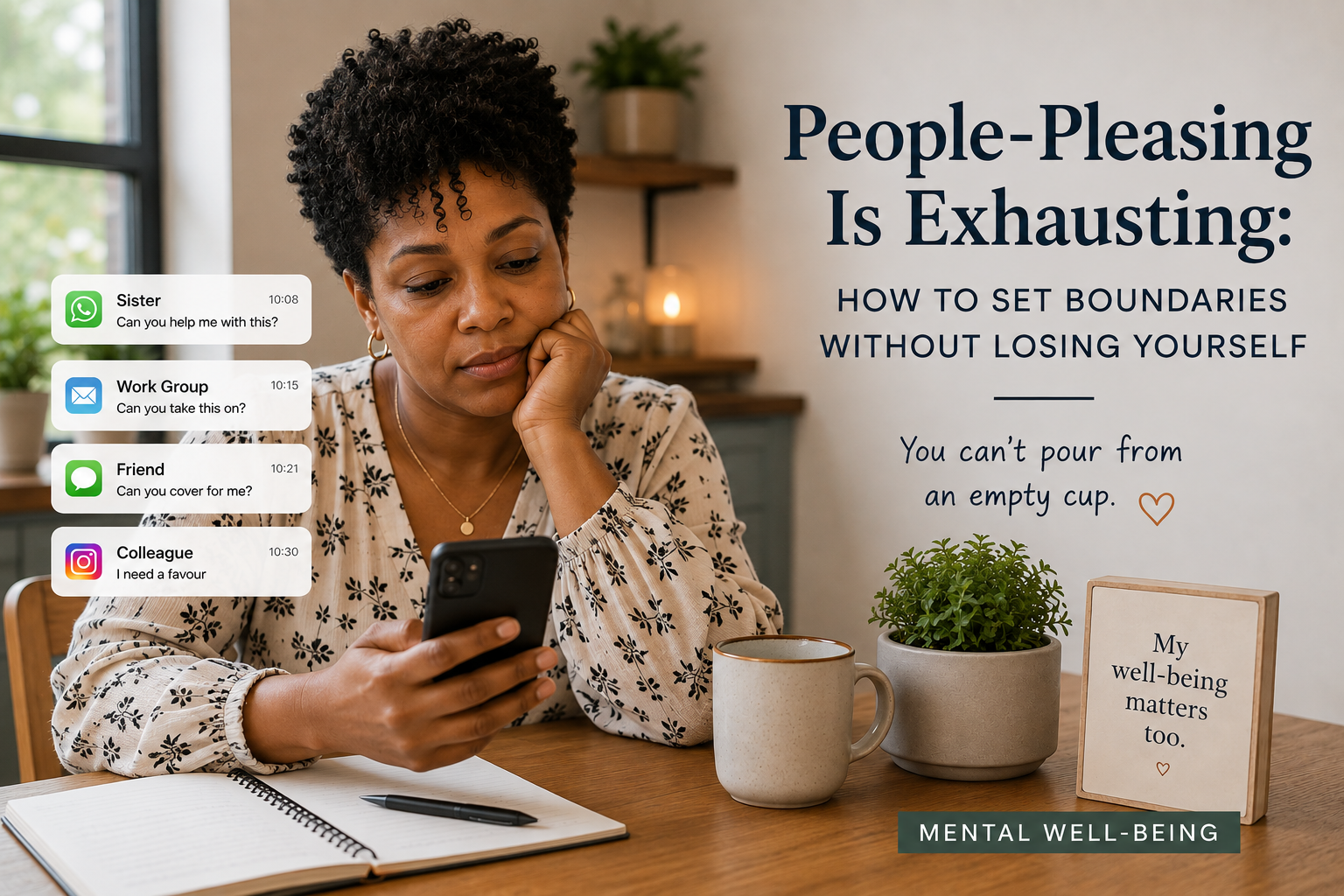
Have you ever said “yes” while everything inside you was screaming “please, not this time”?
You are already exhausted.
You have had a long day at work. There are things waiting for you at home. Your body is asking for rest, your mind is asking for quiet, and you know very well that taking on one more thing is probably not a good idea.
Then someone asks you for a favour.
And before you have even had time to think, you hear yourself saying:
“Yes, of course.”
There it is again.
That little word that seems so harmless but somehow leaves you feeling exhausted, frustrated and, sometimes, quietly angry with yourself.
I know this pattern.
And I have come to realise that people-pleasing is not always about wanting everyone to like you. Sometimes, it is about wanting everyone to be okay—even if keeping everyone okay means you are not okay.
When being the “helpful one” starts costing you
There is absolutely nothing wrong with being kind.
There is nothing wrong with helping a colleague, supporting a friend, showing up for your family or being the person people can depend on.
In fact, kindness is one of the beautiful things about being human.
But there is a difference between choosing to help and feeling that you must help because you are afraid of what will happen if you don’t.
That is where things can become complicated.
You may agree to take on another responsibility at work because you don’t want your manager to think you are difficult.
You may attend a social gathering even though all you really want is to stay home in your pyjamas and enjoy some peace and quiet.
You may lend money you cannot comfortably afford to lend.
You may answer a phone call when you desperately need some time alone.
You may apologise even when you haven’t actually done anything wrong.
You may even find yourself saying “sorry” before explaining something completely reasonable.
And the strange thing?
In the moment, saying yes can feel like relief.
“At least they won’t be disappointed.”
But later, when you are sitting alone with your thoughts, another feeling can creep in.
“Why did I agree to this?”
That is when resentment can begin to grow.
People-pleasing can leave you emotionally exhausted
When you repeatedly put everyone else’s needs before your own, you can end up with very little space left for yourself.
You become overcommitted.
You become tired.
You start cancelling your own plans.
You postpone rest.
You ignore what you actually want.
And eventually, you may not even know what you want anymore.
This is one of the things I find particularly concerning about chronic people-pleasing.
It can become so automatic that you stop checking in with yourself.
Someone asks.
You say yes.
Someone needs something.
You rearrange everything.
Someone is unhappy.
You immediately assume you have done something wrong.
Someone is disappointed.
You feel responsible for fixing their feelings.
And before you know it, you have become the person who is constantly available to everyone except yourself.
If that sounds familiar, you may also recognise the emotional exhaustion I wrote about in my earlier article, “When You’re Emotionally Drained but Life Doesn’t Stop”.
Sometimes exhaustion isn’t simply about how much you are doing.
It is also about how much of yourself you keep giving away.
The hidden cost of always trying to keep everyone happy
People-pleasing can affect more than your schedule.
It can affect how you see yourself.
You may become more anxious
If you are constantly thinking about how other people will react to your decisions, you may spend far too much time worrying about disappointing them.
“Will they be angry?”
“Will they think I’m selfish?”
“What if they stop talking to me?”
“What if my boss thinks I’m not committed?”
That constant mental calculation can become exhausting.
You may become resentful
This one is uncomfortable, but it needs to be said.
Sometimes, we become angry with people for taking advantage of us when we have never clearly told them where our limits are.
That does not mean people are always innocent.
Some people will absolutely take advantage of someone who continually says yes.
But sometimes we also need to examine our own patterns.
If you repeatedly agree to things you don’t want to do and then become angry because people keep asking, perhaps the answer is not simply to blame them.
Perhaps it is time to start saying no.
You may lose touch with yourself
When your decisions are constantly based on what everybody else wants, your own preferences can become very quiet.
What do you want?
What do you have time for?
What matters to you?
What are your priorities?
What are you actually willing to do?
Those questions become surprisingly difficult when you have spent years organising your life around other people’s needs.
You may become exhausted
There are only so many hours in a day.
There is only so much emotional energy you have.
And there is only so much of yourself you can give before something has to give.
Sometimes, the person who looks like they are coping beautifully from the outside is the person who is privately thinking:
“I honestly cannot do one more thing.”
Are you a people-pleaser?
There is no official checklist that can tell you whether you are a “people-pleaser,” but there are patterns worth paying attention to.
You might recognise yourself if you:
- find it extremely difficult to say no
- agree to things before thinking about whether you actually have the time or energy
- worry excessively about disappointing people
- apologise when you have done nothing wrong
- feel responsible for other people’s feelings
- regularly put other people’s needs before your own
- accept unreasonable demands because you don’t want conflict
- struggle to ask other people for help
- change your plans repeatedly to accommodate others
- feel guilty when you prioritise yourself
- avoid difficult conversations at almost any cost
- keep your opinions to yourself just to maintain peace
- become overwhelmed because you have taken on too much
- feel resentful after agreeing to things you didn’t want to do
- constantly need reassurance that people are not upset with you
If several of these sound familiar, don’t immediately start criticising yourself.
The purpose of recognising the pattern is not to give yourself another reason to feel guilty.
It is to give yourself an opportunity to change it.
So, how do you stop being a people-pleaser?
Let’s be honest.
If you have been doing this for years, you probably won’t wake up tomorrow and suddenly become the queen of boundaries.
And that’s okay.
This is not about becoming cold, selfish or uncaring.
It is about learning that your needs deserve a place in your life too.
1. Pause before saying yes
This may be one of the simplest—and hardest—things to practise.
You don’t have to answer immediately.
Instead of automatically saying:
“Yes, no problem!”
try:
“Let me check my schedule and get back to you.”
That little pause gives you something people-pleasers desperately need:
time to think.
You can ask yourself:
Do I actually want to do this?
Do I have the time?
Do I have the energy?
Am I saying yes because I genuinely want to help, or because I am afraid of disappointing them?
That last question can be particularly revealing.
2. Start saying no without writing a whole essay
You don’t need to provide a ten-minute explanation every time you decline a request.
“No” does not need a courtroom defence.
You can simply say:
“I’m not able to take that on at the moment.”
Or:
“I’m sorry, I won’t be able to make it.”
Or:
“I don’t have the capacity for that right now.”
And stop.
The NHS recommends learning assertiveness and practising saying no, particularly when saying yes leaves you overburdened or resentful.
Remember: a boundary is not an attack.
3. Learn the difference between kindness and self-abandonment
Please don’t misunderstand me.
I am not telling you to stop helping people.
I love kindness.
I love generosity.
I love being there for people.
But helping someone should not require you to consistently abandon yourself.
There is a beautiful difference between:
“I want to help you.”
and
“I have to help you because I cannot cope with the possibility that you might be disappointed in me.”
One comes from choice.
The other comes from fear.
And learning to recognise the difference can change everything.
4. Set boundaries at work
This is particularly important if you are the person colleagues always run to because they know you will say yes.
You already have responsibilities.
Someone else’s poor planning does not automatically become your emergency.
If your workload is already full, it is reasonable to say:
“I currently have these priorities. Which task would you like me to move down the list if I take this on?”
That is not being difficult.
That is communicating clearly.
Healthy boundaries are also part of maintaining our mental wellbeing in relationships, and the NHS recommends thinking about what you are genuinely able to help with and sticking to those limits.
5. Stop assuming that someone’s disappointment means you have done something wrong
This one took me a while to understand.
Someone can be disappointed with your answer without you being a bad person.
Someone can dislike your boundary without the boundary being wrong.
Someone can be unhappy that you said no without you needing to change your answer.
We sometimes confuse another person’s emotional reaction with our responsibility.
They are not always the same thing.
You are allowed to disappoint someone.
You are allowed to say no.
You are allowed to change your mind.
And you are allowed to rest.
6. Pay attention to the relationships around you
Ask yourself honestly:
Are my relationships reciprocal?
Do people care about my needs too?
Can I say no without being punished?
Can I express how I feel?
Do people respect my boundaries?
Or have some people become accustomed to receiving from me because I have trained them to expect a yes?
Healthy relationships should leave room for both people.
The Mental Health Foundation also highlights the importance of relationships where boundaries are respected and people can express themselves honestly.
Sometimes the boundary you need is not simply a sentence.
Sometimes it is distance.
7. Remember that you don’t have to earn your worth by being useful
This may be the heart of the entire conversation.
You do not have to constantly solve problems to deserve love.
You do not have to be available every minute to prove that you care.
You do not have to exhaust yourself to prove that you are a good person.
And you certainly don’t have to make yourself miserable just to keep everybody else comfortable.
You are allowed to be a person—not just a helper.
And what if people react differently when you start setting boundaries?
They might.
Especially if they are used to the version of you who always says yes.
Someone might say:
“You’ve changed.”
Maybe you have.
And perhaps that isn’t a bad thing.
Growth can look like becoming less available for things that constantly drain you.
Growth can look like taking a breath before answering.
Growth can look like allowing someone else to solve their own problem.
Growth can look like staying home when you are exhausted instead of attending another gathering because you are afraid someone will be offended.
Growth can look like saying:
“No, I can’t.”
And then resisting the urge to send five paragraphs explaining yourself.
Your boundaries may feel uncomfortable to you at first.
They may even feel selfish.
But discomfort does not automatically mean you are doing something wrong.
Sometimes it simply means you are doing something differently.
You are important too
I was recently talking to someone close to me who has struggled with people-pleasing for years.
She described herself as constantly feeling broken, overwhelmed and mentally drained.
And as we talked, something became very clear.
She was so accustomed to making everyone else comfortable that she had forgotten to ask whether she was comfortable.
She was always available.
Always helping.
Always adjusting.
Always saying yes.
And eventually, she had very little left for herself.
That conversation stayed with me.
Because I think many of us know someone like this.
Perhaps you are that person.
Perhaps you are the one everyone calls.
The one who always helps.
The one who rarely says no.
The one who apologises first.
The one who says, “It’s okay,” even when it really isn’t.
If that is you, I want you to hear this:
You are allowed to care about other people without abandoning yourself.
Kindness should include you too.
Your time matters.
Your energy matters.
Your feelings matter.
Your rest matters.
And your mental well-being matters.
You don’t have to stop being a kind person.
You simply have to stop believing that being kind requires you to disappear.
Start small.
Pause before saying yes.
Practise a simple no.
Set one boundary.
Protect one evening.
Say what you actually feel.
And the next time guilt whispers, “But what will they think?”
perhaps answer it with:
“They may think whatever they choose. I am learning to take care of myself too.”
Because you are not here to please everyone.
You are here to live your life—and you are important in it.