
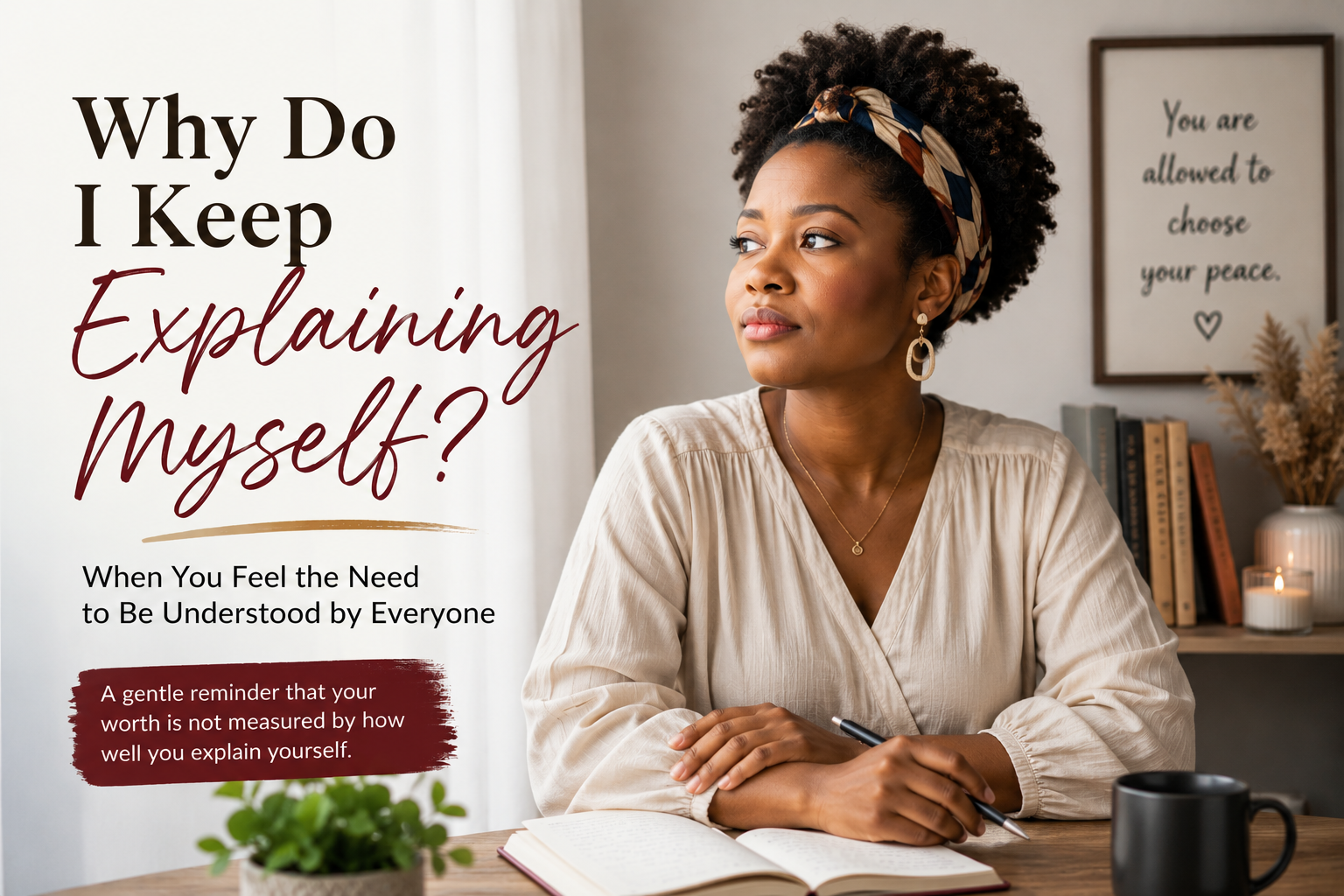
I have caught myself doing this more times than I care to admit.
Explaining.
Sometimes, I explain myself even when nobody has actually asked me to.
I find myself saying things like, “The reason I did that was…” or “Please don’t misunderstand me…” or “That’s not what I meant.”
And sometimes, after I’ve finished explaining, I find myself wondering:
Why did I feel the need to explain all of that?
Perhaps you have done it too.
You make a decision, and almost immediately you feel the need to justify it. You say no to something, then find yourself giving five different reasons why you couldn’t say yes.
You choose to spend a quiet evening at home, but somehow feel compelled to explain that you’re tired, you’ve had a long week, there are things to do tomorrow and you really didn’t mean to offend anyone.
Someone misunderstands your actions, and instead of simply allowing them to have their opinion, you find yourself putting together a whole defence of your intentions.
I know this feeling because, if I’m being completely honest, I sometimes struggle with the idea of being misunderstood.
I want people to know that my intentions were good. I want them to know that I wasn’t being selfish. I want them to understand why I made that choice.
And perhaps that’s where the problem begins.
Because somewhere along the way, we can start believing that being understood by everyone is our responsibility.
But is it?
Do we really have to explain every decision we make?
Do we have to convince everyone that our “no” is reasonable before we’re allowed to say it?
Do we need to keep defending ourselves until the other person finally agrees with us?
Maybe the answer isn’t always to explain better.
Maybe sometimes, we need to become comfortable with not being understood.
And that is a lesson I am still learning myself.
I Didn’t Need the Products, But Somehow I Felt I Needed to Explain
I remember a small interaction with a friend that made me think about this differently.
She was marketing some products and reached out to me, hoping I might be interested in buying some.
The truth was simple.
I didn’t need them.
That was it.
I could have said:
“Thank you, but I don’t need any at the moment.”
That would have been honest and polite.
But somehow, I found myself doing exactly what I had just been thinking about.
I started explaining.
I explained why I couldn’t buy the products. I gave reasons. I wanted her to understand that I wasn’t rejecting her or her business. I wasn’t being dismissive or unkind.
I simply didn’t need what she was selling.
Afterwards, I thought about it.
Why had I felt the need to explain so much?
My friend hadn’t accused me of anything. She hadn’t demanded a reason. She hadn’t made me feel guilty. She had simply offered me something.
Yet somehow, my “no” didn’t feel complete until I had given it an explanation.
That small interaction made me realise something important:
Over-explaining doesn’t only happen during serious disagreements.
Sometimes, it appears in the smallest and most ordinary moments.
Someone invites you somewhere, and you feel the need to explain why you can’t come.
Someone asks you to do something, and instead of simply saying no, you start listing everything that has been happening in your life.
Someone offers you something you don’t need, and rather than simply declining, you begin constructing a case for why you can’t accept it.
The other person may not even be demanding an explanation.
But somewhere inside us, we feel that we owe them one.
Perhaps the real issue isn’t that we don’t know how to explain ourselves.
Perhaps we don’t always feel comfortable simply saying no.
When Your “No” Doesn’t Feel Complete Without an Explanation
There is nothing wrong with explaining yourself when clarification is genuinely needed.
Sometimes communication requires explanation. Sometimes we hurt someone without intending to, and explaining ourselves can help repair a misunderstanding.
Sometimes a situation is complicated, and another person genuinely needs more information.
The problem begins when explanation becomes a constant need for approval.
When every decision has to come with a defence.
When every boundary needs a lengthy explanation.
When every “no” is followed by guilt.
When someone looks disappointed, and your immediate instinct is to start proving that you are not a bad person.
That can become emotionally exhausting.
You are no longer simply communicating. You are trying to control how another person sees you.
And that is an impossible job.
Because no matter how carefully you explain yourself, you cannot control another person’s interpretation of you.
You can explain your intentions. You can tell the truth. You can apologise when necessary. You can correct misinformation.
But you cannot climb inside somebody else’s mind and make them understand you exactly the way you want them to.
That part is outside your control.
Why Do We Feel the Need to Explain Everything?
For some of us, over-explaining may come from a desire to avoid conflict.
We don’t want anyone to be upset with us. We don’t want to disappoint people. We don’t want to appear rude, selfish, difficult or uncaring.
So instead of simply saying:
“I can’t do that.”
We say:
“I’m so sorry. I would have loved to, but I’ve had such a busy week, and tomorrow I have this thing, and then there’s something else I need to sort out…”
We keep talking because silence makes us uncomfortable.
We are hoping that if we provide enough reasons, the other person will approve of our decision.
But here’s something I’ve had to learn:
A reasonable boundary does not become more valid because you have provided ten reasons for it.
Sometimes “I can’t” is enough.
Sometimes “That doesn’t work for me” is enough.
And sometimes, you don’t owe an explanation at all.
The Fear of Being Seen as the “Bad Person”
I think this is one of the hardest parts.
Many of us want to believe that we are good people. So when someone is unhappy with our decision, it can feel almost like evidence that we have done something wrong.
Someone says:
“I can’t believe you would do that.”
And suddenly, we are scrambling to defend ourselves.
“But that’s not what I meant.”
“You have to understand…”
“I only did it because…”
“I wasn’t trying to hurt you.”
Before we know it, a simple disagreement has become a courtroom, and we are both the defendant and the lawyer.
But someone being disappointed in you does not automatically mean you have done something wrong.
Someone disagreeing with you does not automatically mean you are selfish.
Someone misunderstanding you does not automatically mean you have failed.
And someone thinking badly of you does not necessarily make their opinion true.
This becomes especially important when we are learning to establish healthier boundaries.
A boundary may inconvenience someone. It may disappoint someone. It may even make someone angry.
That doesn’t automatically make the boundary wrong.
You Are Allowed to Say No Without Writing an Essay
This is one I am still practising.
There are times when I catch myself trying to make my “no” sound more acceptable.
I want to soften it. I want to explain it. I want to make sure the other person knows that I am still a caring person despite saying no.
But perhaps we sometimes confuse being kind with being constantly available.
They are not the same thing.
You can care about someone and still have limits.
You can love someone and still need space.
You can be generous and still say no.
You can be a supportive friend and still have days when you don’t have the emotional capacity to listen.
You can be a loving partner and still disagree.
You can be a good mother, father, daughter, son, friend, colleague or sibling without being available to everyone all the time.
You don’t have to destroy yourself trying to prove your goodness.
Not Everyone Is Going to Understand You
This may be one of the most uncomfortable truths to accept.
There will be people who misunderstand you.
There will be people who interpret your silence incorrectly.
There will be people who think your boundaries are selfish.
There will be people who remember your mistakes more than your kindness.
There will be people who create their own version of your intentions.
And there will be situations where you explain yourself perfectly and the other person still doesn’t agree.
What then?
Do you keep explaining?
Do you keep sending paragraphs?
Do you keep revisiting the conversation?
Do you keep trying different ways of saying the same thing?
Or do you eventually say:
“I have explained myself. I cannot force you to understand me.”
Sometimes, that isn’t arrogance.
Sometimes, it is acceptance.
The Difference Between Clarifying and Defending Yourself
There is an important difference between clarification and defensiveness.
Clarification says:
“I want to make sure you understand what I meant.”
Defensiveness says:
“I need you to agree that I am a good person.”
Clarification communicates.
Defensiveness seeks validation.
One question can help you recognise the difference:
“Am I explaining this because the other person genuinely needs clarification, or because I am uncomfortable with them being unhappy with me?”
That question can change everything.
Because sometimes, the conversation isn’t actually about communication anymore.
It is about our discomfort with disapproval.
What If They Still Don’t Understand?
This is where emotional maturity can become uncomfortable.
You may explain yourself sincerely. You may speak calmly. You may choose your words carefully. You may apologise for the part that genuinely belongs to you.
And the other person may still walk away believing something completely different.
It hurts.
Especially when you know your heart.
You know what you meant. You know the intention behind your decision. You know the sacrifices you made and the conversations nobody else heard.
Sometimes, you desperately want someone to see all of that.
But they may not.
And you may have to let them have their interpretation.
That doesn’t mean their interpretation becomes your identity.
You Don’t Have to Correct Every Misunderstanding
There is freedom in realising this.
Not every misunderstanding requires a response.
Not every opinion requires a rebuttal.
Not every accusation deserves a defence.
Not every person needs to understand your side.
Sometimes, responding gives a misunderstanding more power than it deserves.
Sometimes, silence is not weakness.
Sometimes, silence is simply recognising:
“I know who I am, and I don’t need to convince everyone.”
Of course, there are situations where speaking up matters.
If someone is spreading harmful lies about you, abusing you, damaging your reputation or making important decisions based on false information, addressing the situation may be necessary.
This isn’t about becoming silent when you need to advocate for yourself.
It is about learning the difference between protecting yourself and constantly proving yourself.
What Happens When You Stop Over-Explaining?
At first, it may feel strange.
You might send a short response and immediately want to add another paragraph.
You might say no and then feel guilty.
You might set a boundary and wonder whether you sounded too harsh.
You might walk away from an argument and spend hours replaying everything you said.
That doesn’t necessarily mean you made the wrong choice.
It may simply mean you are learning a new way of relating to people.
You are learning that discomfort doesn’t always require immediate action.
You are learning that guilt doesn’t always mean you have done something wrong.
You are learning that another person’s disappointment is something they are allowed to experience.
And perhaps most importantly, you are learning that:
You don’t have to abandon yourself just to keep someone else comfortable.
Learning to Trust Your Own Intentions
There is a quiet confidence that comes from knowing yourself.
Not the confidence that says, “I am always right.”
Rather, the confidence that says:
“I know I can make mistakes. I know I can hurt people unintentionally. I know I sometimes get things wrong. But I also know that I don’t have to defend every part of myself to every person.”
That kind of confidence takes time.
It requires self-awareness.
It means being honest enough to admit when you are wrong and secure enough not to apologise simply because someone dislikes your boundary.
It also requires learning to sit with uncertainty.
You may never know exactly what someone thinks about you.
You may never convince someone that your intentions were good.
And you may have to continue living your life without that validation.
That can be difficult.
But it can also be liberating.
You Can Explain Yourself Without Losing Yourself
I don’t think the answer is to stop explaining yourself completely.
There are times when explanation is necessary.
There are relationships where honest communication matters. There are misunderstandings worth resolving. There are apologies worth making. There are conversations that can heal wounds.
But perhaps we need to stop believing that every misunderstanding is ours to fix.
Sometimes you can explain.
Sometimes you can clarify.
Sometimes you can apologise.
And sometimes you can simply let go.
Because your life cannot become a never-ending presentation where you are constantly defending your choices to an audience.
You don’t have to provide evidence for every decision.
You don’t have to make everyone comfortable with your boundaries.
You don’t have to convince everyone that you are a good person.
And you certainly don’t have to keep explaining yourself until you are emotionally exhausted.
Mental health is closely connected to our ability to cope with the stresses and challenges of everyday life. The World Health Organization describes mental health as an important part of overall well-being, not simply the absence of mental illness. World Health Organization – Mental Health
Learning to recognise emotional habits that continually drain us—including the need to constantly seek reassurance or approval—can be part of becoming more emotionally aware.
Perhaps Being Misunderstood Is Not the End of the World
I am still learning this.
I still catch myself wanting to explain.
I still sometimes want people to know that I meant well.
I still struggle with the discomfort that comes when someone doesn’t see things from my perspective.
But I’m learning to pause.
To ask myself:
“Do I actually need to explain this?”
“Is clarification necessary?”
“Am I communicating, or am I trying to convince?”
“Am I protecting a relationship, or am I trying to protect myself from someone’s disapproval?”
And sometimes, the answer is simply:
Let it go.
Perhaps growing emotionally isn’t about becoming someone who never cares what other people think.
Perhaps it is about caring without allowing their opinions to control you.
Because you can be misunderstood and still be a good person.
You can disappoint someone and still have a good heart.
You can say no and still be loving.
You can make a decision that someone else doesn’t agree with and still know that it was the right decision for you.
And sometimes, the most peaceful thing you can say is not another explanation.
It is simply:
“I have explained myself. I don’t need to keep proving what I meant.”
Maybe that is where freedom begins.
Not when everyone finally understands you.
But when you realise that you can be okay even when they don’t.
A Gentle Reminder
If you recognise yourself in this, be gentle with yourself.
Over-explaining is not necessarily a character flaw. It can become a learned response to conflict, rejection, criticism or the fear of disappointing others.
You don’t have to change it overnight.
Start small.
The next time you feel the urge to give a ten-minute explanation for a simple decision, pause.
Take a breath.
Ask yourself whether an explanation is genuinely necessary.
And if it isn’t, allow yourself to say less.
Your boundary can stand.
Your decision can stand.
Your “no” can stand.
And you can stand too.
Sometimes, you don’t need everyone to understand you.
You just need to understand yourself.
Further Reading
If this reflection resonated with you, you may also find these related articles helpful:
When You’re Emotionally Drained but Life Doesn’t Stop: How to Keep Going Without Burning Out
A reflection on continuing to carry life’s responsibilities when you feel emotionally exhausted.
The Silent Grief of Staying in an Unhappy Marriage
A deeper look at the emotional pain that can come from remaining in a relationship that no longer feels like the peaceful home you hoped for.
When Home Doesn’t Feel Like Peace
Because sometimes the place where we expect to feel safest can become the very place where we feel emotionally drained.
The Truths No One Tells You About Divorce: 5 Painful Lessons to Learn
For anyone navigating the emotional reality of relationship breakdown, loss and rebuilding.
This article is intended for mental-health awareness and personal reflection. It is not a substitute for professional mental-health advice, diagnosis or treatment.




Pingback: When Social Media Turns Cruel: The Mental Health Cost - My Psyche and Yours